
Founded to measure
Built to change
Målbar began inside a Danish furniture company, when two people needed a way to prove the climate impact of decisions they were already making. Six years on, that’s still where every Life Cycle Assessment (LCA) we build starts: measure what’s real, then use it to change something.
If a CO2eq number is going to be used for a claim you make to a customer, an auditor, or a regulator, you want to know where it came from and who stands behind it.
Målbar’s founders ran into that exact problem from the inside.
Where it started
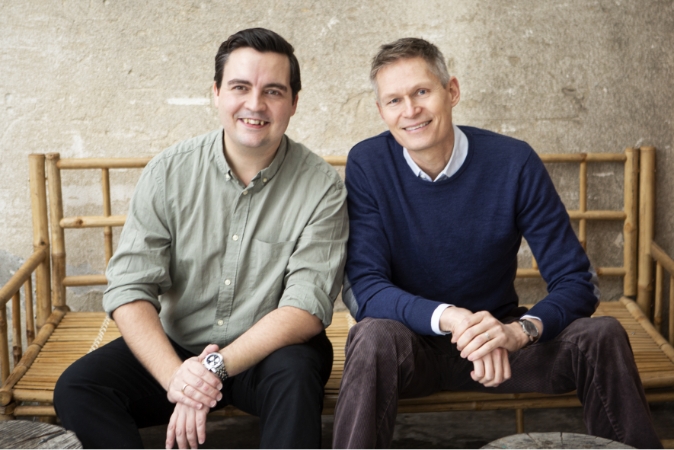
In 2020, Anders Koefoed and Jakob Aaen were both working for the same Danish furniture company. Anders as Head of CSR and Product Development, Jakob as Head of International Sales. Between them, they kept hitting the same wall: there was no shared language for describing the climate impact of a chair, a table, or a sofa that held up, internally or when a customer started asking hard questions.
“We simply needed a better way to communicate the impact of positive and thoughtful decisions taken in CSR departments,” as Jakob Aaen put it at the time. “Both for internal use, to lift the common knowledge, and externally, to secure better commercial excellence.”
Anders had already spent more than two years building a tool to close that gap. That tool became the starting point for Målbar.
Why furniture, and why climate first
Furniture and interior design weren’t an arbitrary starting point. Furniture accounts for around 36%* of the mass of household goods Europeans consume, but 28.6% of the climate impact behind them roughly 300 kilograms of CO2eq per person, per year, across the EU. For an industry with that footprint, most companies still had no structured way to measure their own numbers, let alone document them for a customer or a regulator.
Målbar picked climate change as the first focus deliberately. Not because it’s the only sustainability issue that matters, but because it’s the most measurable, the most urgently regulated, and the one furniture and design companies were being asked about most often.
One definition, kept narrow on purpose
Målbar works from the definition of sustainable development set out in the Brundtland Report in 1987: Development that meets the needs of the present without compromising the ability of future generations to meet their own. It’s a broad definition, and we treat it deliberately narrowly in practice.
Rather than spread a small amount of insight across every measure of sustainability at once, we focus on the one companies are asked about most: CO2eq.

A number you can stand behind
An LCA is only useful if the people relying on it can trust it. And trust starts with knowing exactly what’s inside the number.
Every footprint Målbar produces is built on documented system boundaries, consistent emission factors and datasets, and a clear account of where the data came from and how reliable it is. Assumptions are written down, not buried. Where the input data is uncertain or approximated, that’s flagged rather than smoothed over.
Many of the companies we work with use these numbers as the basis for ESPR, CSRD, or CBAM reporting, or for EU Taxonomy alignment. That’s exactly why the documentation trail matters as much as the number itself. It’s the difference between a figure you can show your own management, and one you can hand to an auditor or a large customer’s procurement team without having to explain it away.
When you need someone else to check the number
Some claims need more than good internal data behind them. They need independent verification.
When that’s the case, Målbar’s verification team reviews input ranges, checks the plausibility of assumptions, runs mass balance checks across materials and processes, and flags anything missing or inconsistent. You get a structured verification report, a data quality and qualification overview, and a clear statement of what the review covers and where its limits are.
That level of review is enough to communicate a CO2eq result for B2B.
Comparative claims, or a full Product Environmental Footprint (PEF) study intended for external end-consumer oriented communication, need a full critical review panel under ISO 14044. Målbar supports you through that process, ensuring your Målbar LCA results hold up under scrutiny.
Deep in furniture. Not limited to it.
Målbar started in furniture and design, and that’s still where our data runs deepest. Material data, emission factors, and industry defaults built up over years inside the sector. The methodology behind it isn’t specific to a chair or a sofa, though. The same system boundaries, the same emission factor logic, and the same documentation standard apply to any product Målbar measures.
That’s the standard, whatever comes next.
Decency, transparency, honesty
Those three words come up often inside Målbar, in how we work with each other and with our customers. In practice, that means telling a customer when their data isn’t good enough yet, rather than smoothing over the gap. It means being specific about what a number does and doesn’t prove. And it means treating a customer’s uncertainty about where to start as normal, not as a problem they should have already solved.
You don’t need to arrive with a finished dataset or a settled value chain overview to talk to Målbar. You need a product, a process, or a claim you want to understand properly. The rest is where we come in.

Not sure whether Målbar’s approach fits your product, your industry, or your timeline?
* Sanyé Mengual, E. and Sala, S., Consumption footprint and domestic footprint – Assessing the environmental impacts of EU consumption and production – Life cycle assessment to support the European Green Deal, Publications Office of the European Union, 2023, https://data.europa.eu/doi/10.2760/218540