
Product manufacturing
When modelling the manufacturing of your product you can choose between the typical processes for industrial production in all materials.
If we take one example of a wooden based board product manufacturing modelling typically consists of cutting, gluing and assembly processes followed by surface treatments.
Energy demand in this process is primarily driven by factory temperature control and finishing activities.
The modelling of this manufacturing step includes:
- The manufacturing steps of cutting, gluing, assembly, surface finish and factory utilities. The need for electricity and heat is based on Ecoinvent’s “furniture production, wooden, 1kg, global” as it models wooden based board manufacturing.
- Explicit inclusion of material waste and manufacturing losses
- Separate modelling of high energy need surface treatments such as wet painting
- Variation across product types to reflect real manufacturing complexity
Manufacturing
We model manufacturing energy using Ecoinvent’s dataset “furniture production, wooden”.
The dataset is based on life cycle assessments of nine representative furniture products covering low- and medium-volume production.
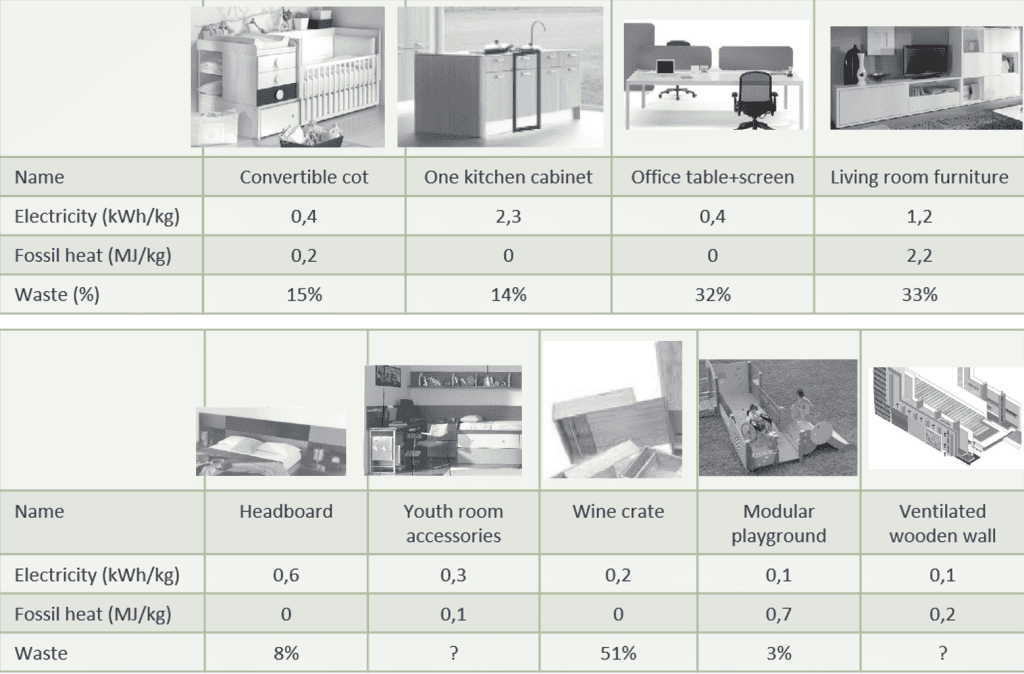
Source: Assessing the global warming potential of wooden products from the furniture sector, González-García et al. (2011)
Heat demand in the dataset is fossil-based.
Wet painting, solid wood manufacturing and plywood moulding are modelled as separate processes in the Målbar platform as they are only included in very limited amounts in the above production examples of the LCA.
As can be seen the material waste varies significantly depending on product type.
Across the underlying studies, the average waste rate is approximately 22%. But Målbar LCA assigns average material specific waste rates based on our costumer’s statistical supplier data.
Electricity mixes and heat datasets are geographically specific.